- Lifestyle
Is it time to bring back the punch bowl?
The twentieth-century’s obsession with personal cocktails did for the classic communal punch. But you just can’t keep a good drink down (so to speak)
- Words By Molly Steemson
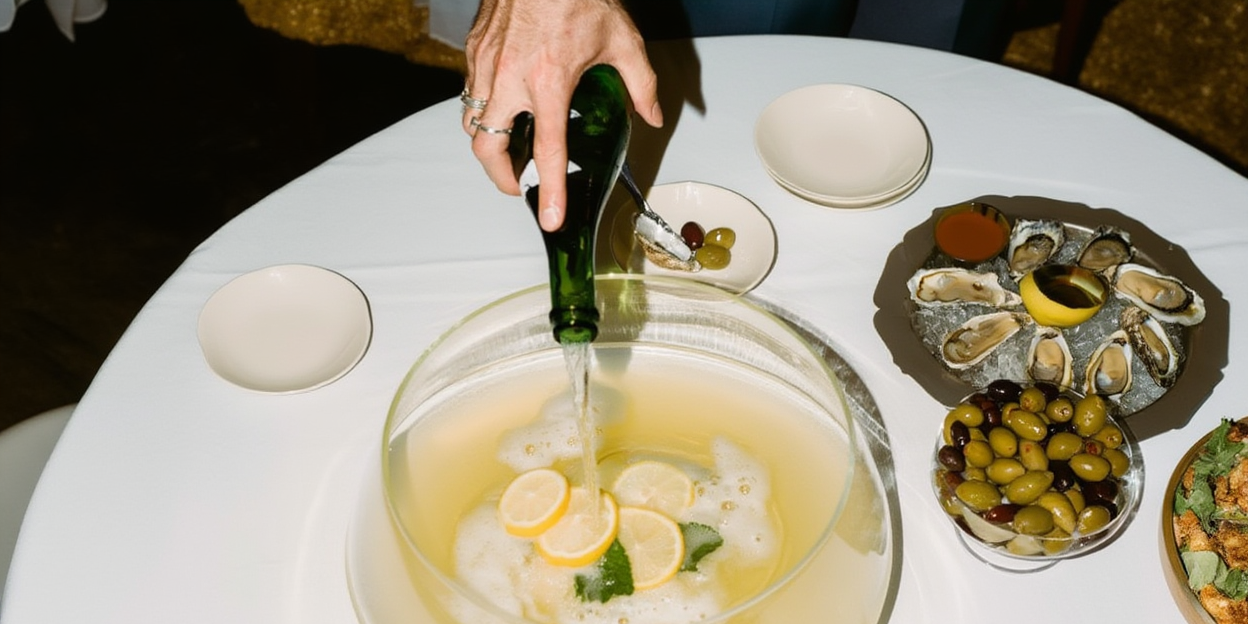
The twentieth century saw the decline of all sorts of things: domestic travel by horse, international travel by boat, the use of public libraries, the wearing of hats. I find these things depressing (I never get seasick, look excellent in hats) but none more depressing than the decline of a truly great drink—no, an institution—punch.
Now, let me tell you the story of punch.
The word punch derives from the hindu paunch, meaning ‘five’ as there were five ingredients: alcohol, water, lemon juice, sugar, and spice. There were exceptions to this rule when things like milk, or curd, or honey were added, but there are always exceptions to things, and so we proceed.
‘Punch’ became fashionable in England in the late 1600s when it was brought over by employees of the East India Company. Western punches had started out with wine or brandy bases, but that changed with the import and popularity of Jamaican rum. By the end of the century, punch, as we (sort-of) know it, was everywhere. The upper classes started using punch to show off, making increasingly elaborate, ornate and, of course, expensive punchbowls to use at their parties. Punch-drinking, like all drinking, became a rite, ritual, and status symbol.
By the end of the century, punch, as we (sort-of) know it, was everywhere.
In 1964, in his house in Spain, royal naval officer Admiral Edward Russell threw a party. It stands to reason that status was on his mind. He filled the fountain in his garden with 250 gallons of brandy, 125 gallons of wine, 1,400 pounds of sugar, 2,500 lemons, 20 gallons of lime juice and 5 pounds of nutmeg. His bartenders paddled the treacherous juice in purpose-built wooden canoes, with certain accounts suggesting they were swapped out every quarter-hour to save them from getting too drunk, or delirious, or passing out on the fumes of the stuff. The party lasted as long as the punch did—a highly commendable eight days—with the festivities only pausing briefly to erect a silk canopy during a rainstorm so as the punch not get watered down. This was peak punch, and although its popularity increased, it was all (inevitably) downhill from there.
Now, if you don’t mind, I will fast-forward to the (calamitous) 20th century. To 1930, in fact, when Harry Craddock and the Savoy Hotel had just published The Savoy Cocktail Book (which, an astonishing 95 years later, is still in print). The longevity and success of the book really relied on one thing, that same thing that hammered every nail into the punchbowl-shaped coffin of history: the rise of the individual cocktail. No longer was it fashionable to sip from the communal trough—instead, people were encouraged to have their own, personal taste. Of the 300 pages of the book, only 6 are dedicated to Punch.
But what six pages they are. The chapter opens with the first verse of Oliver Wendell Holmes’ On Lending A Punch-Bowl

This ancient silver bowl of mine, it tells of good old times,Of joyous days and jolly nights, and merry Christmas times;They were a free and jovial race, but honest, brave, and true,Who dipped their ladle in the punch when this old bowl was new.
Craddock is telling us something important, here: the bowl is just as important as the punch. Good punch is about drama, it’s about sharing, it’s about ladling a drink into someone else’s cup, and then ladling that same drink into your own.
A few years ago, an ex-boyfriend and I were shopping in a small town in Devon. We did all of the things you’re meant to do in a small town in Devon: buy west-country cheeses, have a sandwich at the deli-café that’s owned by the local judaeo-christian cult, go to the junk and antique shops. You know, the usual English countryside thing.
We had a nice relationship, one of balance. He was practical (“if we buy the ice cream now, it’ll melt in the car”) and I was impulsive (“there was an offer on Magnums, so I’ve bought 24 of them”), which were dynamics that played out all across our relationship. They really came to the fore, however, in one Devonian charity shop.
“But I need it.”
“Molly, you don’t need it.”
“Yes I do.”
“Where are you going to put it?”
“In the cupboard.”
“It’s not going to fit in the cupboard.”
“Well then I’ll put it on the side.”
“But you’ll never use it.”
“Yes I will.”
“No you won’t.”
We repeated those final two lines over and over, like children.
We were, of course, discussing a punchbowl. It was glass, orange lustreware, with matching little cups that hung from their handles on hooks around the rim. Its ladle was glass, too. It was enormous, and fabulous, and would’ve looked entirely at home on top of Liberace’s credenza.

It was glass, orange lustreware, with matching little cups that hung from their handles on hooks around the rim. Its ladle was glass, too.
They say you regret the antiques you do not buy; they’re right. Punchbowl resentment was a major part of our (otherwise harmonious) breakup. Punchbowl resentment has, ever since, been a major part of my life.
I was brought up in the 90s and early 00s, by middle-class parents who thought that punch was the epitome of gauche (they were wrong). I had no exposure to the pleasures and perils of the punchbowl until I moved to Canada for university. There, the frat boys plied us with punch (they call it jungle juice) made from Cranberry Juice, Orange Juice, and a 97% proof clear spirit called, simply, Alcool. This punch came with forbidding tales of tears and puke and temporary blindness. The bowl was often a bucket. The little mugs were red solo cups. There was no charming ladle, we just scooped our plastic cups straight in and licked the drips off our fingers. I loved it. Drinking it made me feel like I was in a movie.
But it’s a far cry from the origins of punch: frat parties are decidedly not elegant affairs. As Craddock says in his introduction to Punch, “the preparation of Punch requires considerable care… that the various subtle ingredients be thoroughly mixed in such a way that neither the bitter, the sweet, the spirit, nor any liquor be perceptible the one over the other”. Making a punch is a lovely thing. It alleviates pressure to choose. It’s convivial. It’s right. And with the right bowl, and the right ladle, it can be eminently chic, too.
What follows, is a punch recipe for our time. It’s not quite the punches of yore, but it’s certainly not Jungle Juice, either. It’s a take on the Savoy Cocktail Book’s Rhine Wine Punch, and I serve it in a large, metal mixing bowl, with a stainless steel ladle, which I stack Duralex tumblers beside. It’s a sort of St. John-inspired punch aesthetic. I am still harbouring my punchbowl resentment, and am still avidly on the lookout for another that’s as good.
Molly’s Punch
2 bottles of German Riesling (above 9% ABV, so as not to be too sweet)
1 bottle (750ml) of sparkling water
2/3 cup of Maraschino
1cup of Brandy
12 teabags
Combine the ingredients and stir, then leave, in the fridge, with the 12 teabags in for at least twenty minutes.
Then decant into your bowl, with a large block of ice (you can freeze the bowl with water at the bottom of it, if you have the space) and serve with halved black cherries and slices of lemon floating in it.
Come on in the Chablis lovely, Your new home of drinks.
Stay up to date with all the latest from House Of Decant.


